
Frequency Range
600 Hz to 1.5 GHz direct, up to 2 GHz via harmonics. Covers HF, VHF, UHF, and into the microwave bands.
The NanoVNA-H is a handheld, battery-powered Vector Network Analyzer capable of measuring RF devices from 600 Hz to 1.5 GHz (and up to 2 GHz using harmonics). It has two SMA ports for reflection (S11) and transmission (S21) measurements, a resistive touchscreen, and a USB interface for PC control.
It fits in your hand. It runs on a coin-cell-sized lithium battery. And it can tell you whether your antenna is tuned, your filter is working, or your feedline has a fault — with enough accuracy to make real engineering decisions.
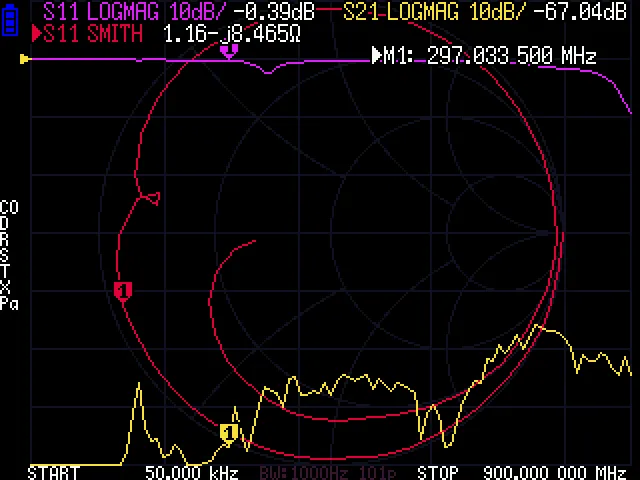
Frequency Range
600 Hz to 1.5 GHz direct, up to 2 GHz via harmonics. Covers HF, VHF, UHF, and into the microwave bands.
Two-Port Measurement
S11 (reflection) and S21 (transmission) with full magnitude and phase. Measure antennas, filters, cables, and components.
Standalone Operation
Touchscreen UI, battery power, SD card storage. No computer required for measurements in the field.
Open Source
GPL-licensed firmware, published schematics, community-maintained. Build it, modify it, extend it.
The NanoVNA-H generates a stimulus signal using a Si5351 frequency synthesizer, sends it out Port 1, and measures what comes back (reflection) and what passes through to Port 2 (transmission). The return signals are downconverted by a mixer to an audio-frequency IF, digitized by a TLV320AIC3204 audio codec at 192 kHz, and processed by the STM32 microcontroller to extract magnitude and phase.
flowchart LR
  SRC["Si5351<br/>Synthesizer"] --> P1["Port 1<br/>(CH0)"]
  P1 --> DUT["Device<br/>Under Test"]
  DUT --> MIX["SA612A / NE602A<br/>Mixer + Codec"]
  DUT --> P2["Port 2<br/>(CH1)"]
  P2 --> MIX
  MIX --> MCU["STM32<br/>DSP + Display"]
After calibration, systematic errors from cables, connectors, and the VNA itself are mathematically removed — leaving you with accurate measurements of just the device under test.
The NanoVNA-H comes in two models sharing the same firmware codebase:
| NanoVNA-H | NanoVNA-H4 | |
|---|---|---|
| Display | 2.8” (320×240) | 4.0” (480×320) |
| MCU | STM32F072 (Cortex-M0) | STM32F303 (Cortex-M4 with FPU) |
| Max Sweep Points | 101 | 401 |
| Calibration Slots | 5 | 7 |
| USB Connector | Micro-USB | USB Type-C |
Both cover the same frequency range and use the same measurement architecture. The H4 offers a larger display, more sweep resolution, and faster processing thanks to its hardware floating-point unit.
See Hardware Variants for a detailed comparison.
The NanoVNA-H traces its lineage through several open-source projects:
The firmware runs on ChibiOS, a real-time operating system, and is built with the ARM GCC toolchain. The hardware schematics are published and the firmware source is GPL-licensed.
| Parameter | Value |
|---|---|
| Frequency Range | 600 Hz – 2 GHz |
| Dynamic Range (direct band) | > 70 dB |
| Dynamic Range (harmonic band) | 40–50 dB |
| Port Impedance | 50 Ω |
| Connector | SMA female |
| Maximum Input | +10 dBm |
| IF Bandwidth | 30 Hz – 4 kHz (selectable) |
| Battery | 3.7 V Li-ion |
| Weight | ~100 g |
For complete specifications, see the Specifications page.
Optional: